














Seoul meets the Sun Devil spirit
Fulton Schools strengthening academic and research ties with South Korea

Gail-Joon Ahn, a professor of computer science and engineering in the School of Computing and Augmented Intelligence, part of the Ira A. Fulton Schools of Engineering at Arizona State University, speaks to a delegate team from South Korea. Last summer, the Fulton Schools hosted a visit as part of the U.S. Department of State’s International Visitor Leadership Program. Photo courtesy of Gail Joon-Ahn/ASU
Technology knows no borders and neither does innovation. That’s the spirit driving faculty members and students in the Ira A. Fulton Schools of Engineering at Arizona State University to expand connections with South Korea, one of the world’s leading technology powerhouses.
“International cooperation is no longer optional. It’s essential,” says Gail-Joon Ahn, a Fulton Schools professor of computer science and engineering and a leading cybersecurity researcher.
Through global outreach efforts and research collaborations, the Fulton Schools is building bridges that connect Arizona’s innovation ecosystem with South Korea’s thriving research and technology landscape, opening doors for students, faculty and new discoveries that transcend geographic boundaries.
Diplomacy meets discovery
Earlier this year, the cybersecurity team in the School of Computing and Augmented Intelligence, part of the Fulton Schools, welcomed a distinguished delegation from South Korea participating in the U.S. Department of State’s International Visitor Leadership Program, or IVLP. The group, comprising leaders in technology, government and policy, spent a day at ASU learning about the university’s computer security initiatives, leadership in artificial intelligence, or AI, and commitment to international collaboration.
The visit was more than a meet-and-greet. It was an exchange of ideas between experts who share a vision for a safer, smarter and more connected digital world.
Ahn, who led the presentation, shared his team’s broad cybersecurity capabilities — from trusted computing and identity management to critical infrastructure protection. The discussion centered on how universities like ASU can play a central role in shaping cybersecurity policy, workforce development and applied research.
“The meeting was very productive,” Ahn said. “Their primary purpose for visiting the U.S. was to learn from ASU’s model and see first-hand how we integrate research, education and innovation in cybersecurity and AI.”
The visitors’ roles ranged from technology ministry officials to cybersecurity researchers and underscore how seriously South Korea approaches global collaboration.
The meeting highlighted shared challenges and opportunities in an era in which digital threats don’t stop at the international date line. It also set the tone for continued collaboration between ASU and Korean institutions, paving the way for future exchanges of both ideas and talent.
A meeting of minds
In September, the Fulton Schools hosted another high-profile visit: this time from Soongsil University, or SSU, one of South Korea’s oldest and most respected private universities.
Founded in 1897, SSU has grown into a research-intensive institution at the forefront of AI and cybersecurity education. Its president, Yun-Jae Lee, visited as part of a U.S. tour of leading research universities. The delegation aimed to learn about ASU’s approach to innovation, particularly about its highly ranked online programs and leadership in AI education.
The visit, coordinated by Ahn and the Fulton Schools leadership, reflected the growing synergy between the two universities. ASU and SSU have already collaborated on multiple research projects, including cybersecurity and vehicle systems security. Ahn’s long-standing ties with SSU, where one of his former students now leads a key security research group, helped make the meeting even more impactful.
Ross Maciejewski, director of the School of Computing and Augmented Intelligence, says he hopes the visit will lead to new opportunities for students and faculty members.
“There’s an incredible energy that comes from sitting across the table from another university halfway around the world and realizing you’re working toward the same goals,” Maciejewski says. “That shared excitement about technology and education can really spark powerful exchanges.”
The agenda for the day included faculty research presentations and discussions on potential student exchange programs, joint AI research and the future of data science collaboration.
The meeting also came at an exciting time for ASU’s global education efforts. In 2026, the Fulton Schools will launch a faculty-led summer study abroad program in Seoul, giving ASU students hands-on experience with Korea’s vibrant tech ecosystem. These initiatives complement each other. SSU’s interest in AI and cybersecurity aligns seamlessly with ASU’s mission to train globally minded engineers.
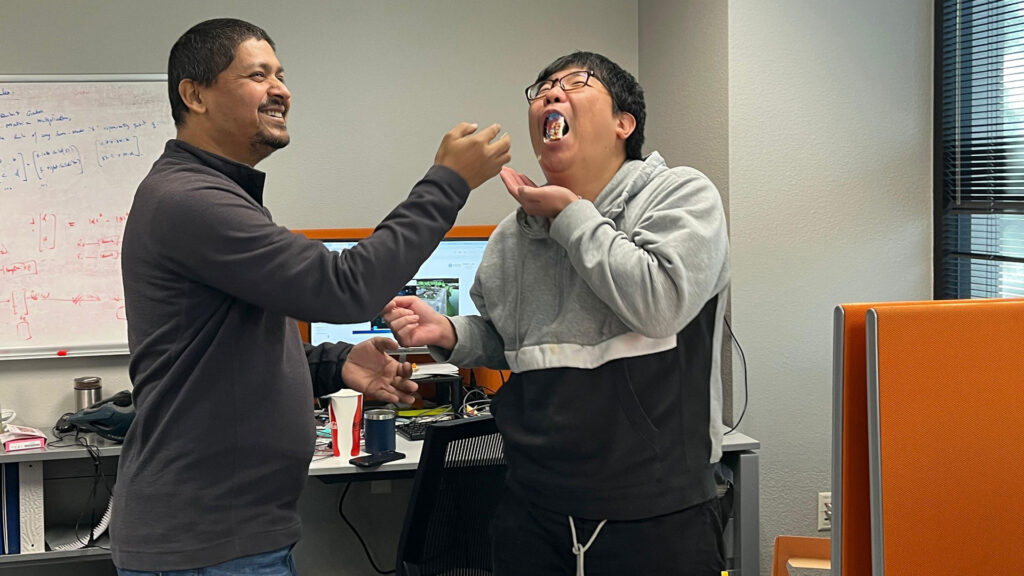
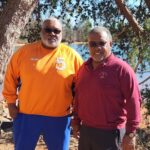
This takes the cake! Aviral Shrivastava (left), a Fulton Schools professor of computer science and engineering, and Hwisoo So, who recently completed work as a postdoctoral scholar in the School of Computing and Augmented Intelligence, take a break during their research. Since leaving ASU, So has assumed a faculty position at Kyungpook National University in Daegu, South Korea. Photo courtesy of Hwisoo So
Researcher, collaborator, innovator
Institutional partnerships can open doors, but it’s people who truly keep collaboration moving forward. Hwisoo So, who completed his postdoctoral research at ASU, has now taken that experience home to South Korea, where he’s started a faculty position at Kyungpook National University.
Working with Aviral Shrivastava, a Fulton Schools professor of computer science and engineering, So spent two years in the Make Programming Simple Lab, researching system reliability and making computing systems more resilient to hardware faults, software bugs and adversarial attacks on machine learning models.
“Reliability isn’t just a technical problem. It’s a human one,” So says. “We rely on computing systems in airplanes, cars, hospitals and finance. A single fault can have enormous consequences.”
While at ASU, So’s research explored how to detect and correct these faults through software-level solutions rather than expensive hardware redesigns. His projects spanned reliability in machine learning, compiler optimization and real-time systems.
“Dr. So brought tremendous energy and creativity to our research group,” Shrivastava says. “He has a rare ability to approach complex reliability problems from both a hardware and software perspective, and that combination led to some truly innovative solutions. His work has strengthened our ongoing collaborations with universities in South Korea and set the stage for future joint research.”
For So, ASU was more than a workplace. It was a launchpad. During his time in Tempe, he not only advanced his research but also mentored visiting Korean students and helped expand the collaboration network between ASU and institutions in South Korea.
“I hope to continue this collaboration long-term,” he says. “We’ve already been working together for nearly a decade. I want to create opportunities for students from Korea to visit ASU, experience global research firsthand and focus deeply on their projects.”
Beyond the lab, So made the most of his time in Arizona, often biking to Tempe Town Lake in the evenings or visiting the Grand Canyon with fellow researchers.
“Arizona’s natural beauty was unforgettable,” he says. “And ASU’s research environment was inspiring. It’s a place that truly values collaboration.”
Shared futures, shared innovation, shared success
From high-level visits to individual success stories, ASU’s connections with South Korea are more than symbolic. They’re a reflection of a shared commitment to advancing technology for the global good.
As So embarks on his faculty career, and as SCAI deepens partnerships with institutions like Soongsil University, the collaboration between ASU and South Korea is poised to grow even stronger.
“Global challenges demand global solutions and strong partnerships,” Ahn says. “Whether in Tempe or Seoul, researchers are united by the same drive — to make technology safer, smarter and more human-centered.”
And as ASU continues to forge global connections, those bridges will carry ideas, knowledge and people toward a shared future of discovery.